:WARNING - This blog contains spoilers for Lola Rennt // Run Lola Run :

For our first film, we watched and discussed Lola Rennt, (or the American Run Lola Run). The film came out in 1998 and was directed by Tom Tykwer. The film itself is about a young woman, Lola, who finds herself with twenty minutes in which to come up with a way to save her boyfriend, Manni, from the fate that awaits him when it's found out that he's lost 100,000 marks of another man's money. And he's of course the last kind of man you'd want to owe money to. If Lola doesn't come up with the money in time, Manni plans to rob a store to help make up for it.
As the film progresses, we see three distinct sections. In the first, Lola runs to her father, a banker, to ask for the money, but instead finds out he's leaving her and her mother for another woman. With little time left, she tries to at least stop Manni, but arrives too late, after he's already began the robbery. She attempts to help him and at first the seem to succeed, until the police show up, and in a moment of distraction, Lola is shot. As she lays dying, we are treated to an intimate moment of her and Manni where Lola asks him how much he loves her. He tries to convince her of the lengths he would go to for her, but she does not completely subscribe to it, convinced that if she'd died, he'd be saying the same thing to another woman. When we come back to the street, Lola says she is not ready yet.
We are transported back to the start of her run, and she begins the journey again, running down the stairs of her apartment, just as before. Only, this time, a man and his dog that she had passed in the previous Run unharmed, now trip her down the stairs and she's injured. Her journey is slightly slower now and she reaches her father's a little later, after he finds out that his aforementioned mistress is pregnant with another man's baby. Fed up with people before she even gets to the bank, Lola's father doesn't even give her enough time to describe her predicament. Lola, running out of time, decides instead to rob the bank. This goes off successfully, and she runs to meet Manni, catching up with him just before he wants into the store he plans to rob. However, just as the two relax and start to walk away, Manni is hit by an ambulance that was rushing a man to the hospital. Now, it is Manni who lays in the street dying. Here, we go back to that intimate moment, and this time it is Manni who is asking the questions. He asks Lola what she would do if he died. Going back to the street, Lola tells him "not yet".

For the third time, we go back to the beginning. Lola learns from her mistakes and begins to act accordingly, jumping over the dog and bounding off to meet her father. We find out that a man Lola had run into in Run One and Run Two, causing him to get into a car accident both times, finally arrives to his destination on time in Run Three. The destination happens to be picking up Lola's father from the bank, so when she gets there, her father has already gone. Out of options, she decides to keep running until she comes up with a new idea and ends up at a casino. She's allowed to play only two games of roulette before making the money she needs and running off to meet up with Manni. In this Run, Manni happens across the man who took the original money and after giving chase, finally retrieves it. Lola arrives to the square where she planned to meet Manni only to see him shaking hands with the man he owed the money to. All is well and the two walk off together.
The major themes we discussed in the class concerned the ideals of free will vs. determination, liebestod, and the idea of turning back time to try again.
The varying outcomes of each Run suggests that the idea of "determination", where your life is already written out for you, is a falsehood. Similarly, the minor changes that occur in the separate Runs, for instance leaping over the dog in Run Three saves her time that merely passing by the dog in Run One didn't ultimately causing her to miss meeting her father instead of talking with him, would lend itself to the idea that even minuscule changes can have impressive effects on our futures.
The theme of liebestod, or love/death, is underlined by the use of the colour red in the film (Lola's hair is red, and the two intimate scene bookends are washed in red, and is the uncommon colour of the ambulance the runs over Manni in Run Two,). Liebestod is also shown by the deaths of Lola and Manni in Runs One and Two, respectively, as well as the implied death of Lola's father in Run Three, which is the only outcome where is happily accepts his mistress without confronting Lola and disowning her.
Reflection Questions for Lola Rennt
(choose and respond to two questions from a provided list)
3) Describe the music. When is techno music used in the film? What is the difference in the text of the predominate song that accompanies the three runs? What other styles of music can you identify in the film?
Now, unfortunately we ran out of time at the end of the class and we didn't get to talking about the music, which is unfortunate because the music is usually the first thing I notice about a film. The music in Lola Rennt was chosen very well and brings up more interesting points.
The majority of the music is techno, with only one really noticeable exception. During the getaway from robbing the store in Run One, when it at first seems that Lola and Manni might be okay, the song "What a Difference a Day Makes", originally by María Grever, plays. The song's message is appropriate really for the entire film, expressing how much one's life can changed based on meeting another person. Lola's life changes because someone stole her moped, causing her to be late picking up Manni, who takes the metro and loses the money. Various people's lives through the film also change as a result of their encounters with Lola. During each run, their varied lives are shown through a series of Polaroids. However, the song has a much slower tempo than the rest of the music in the film and when it is played, it is actually quite jarring. This in fact lends itself to giving the audience the feeling that, despite the appearance that all is well, something is wrong and this story is far from over.
The music throughout the rest of the film, particularly in the beginning, is fast paced and keeps the audience's heart rate up along with Lola's in her running across Berlin. In fact, the writer/director of the film itself, Tykwer, also had a hand in writing the music and its lyrics, so it becomes all the more fascinating when we listen to the words.
In the Run One song, she talks about how she wished she was princess who had armies at her command and a writer who sees what's yet unseen. The majority of the lyrics in the first song as somewhat passive. She's hoping merely for the power to make others do her bidding or for someone/something to show her what she's not seeing. Like Lola running ask her father for help, the sentiment is of finding someone else to do the action that will help her help Manni.
In the song, Run Two, the lyrics change. They express a need to never let go and a strong desire for a more active hand in the situation. She wants to go, to fight, to rush. There's more determination and conviction: "We will kiss, we will laugh, we will be a part of what is said to be a union of the heart." This determination is shown in her resolve as she goes as far as robbing a bank in order to obtain the 100,000 marks. An aggressive action to get what she needed.
The third song does transition back into the same lyrics as the first, but instead, the words that stick out the most are no longer the ones that seem passive. The most prominent lyrics are of a wish to be a hunter in search of different food, the wish to be a person with unlimited breath, to be a heartbeat that never comes to rest. Instead of emphasizing other people helping Lola, the lyrics instead emphasize her finding the strength within herself to be the active one in the situation, to be the one who helps herself, finds the solution. It underlines Run Three as, instead of asking her father for the help, she finds a way to help herself.
The music of Run Three is interestingly accompanied by this:
The percussion and vocals lend themselves to a northern African tribal feel, like a Sahara hunt. This portion underlines the primary lyrics of Run Three, "I wish I was a hunter in search of different food," occupying Lola's hunt for a solution to saving her love. A different solution, since her first plan, going to her father, did not work.
Furthermore, it gives a strange, mystical feeling, which plays well with people's reactions to Lola when she goes into the casino. She implores the woman at the front to allow her entrance despite her shabby look and shortage of money. The woman obliges and Lola puts her money down on the roulette table. When she wins, and subsequently puts her winnings directly back onto the table, everyone else just looks at her, stunned. One of the casino employees tells her she has to go, but again, she asks him to let her stay for just one more game. There is such earnest in her that he allows it, but it is almost as if she has a much more powerful effect on him; like she is an animal of beauty that he can't quite understand.
This sentiment is felt again when Lola later hitches a ride in the ambulance that had killed Manni in Run Two. At first the EMT shouts at her that she has to leave, but when the patient is enraptured with her and she holds his hand, connecting with him as he recovers, you again feel that overwhelming power of hers.
The music plays such a strong suit in the film, it is definitely worth studying the soundtrack and then revisiting the film.
7) Does Lola change at all in the course of the three running sequences? Why does Tykwer reward her with success at the end?
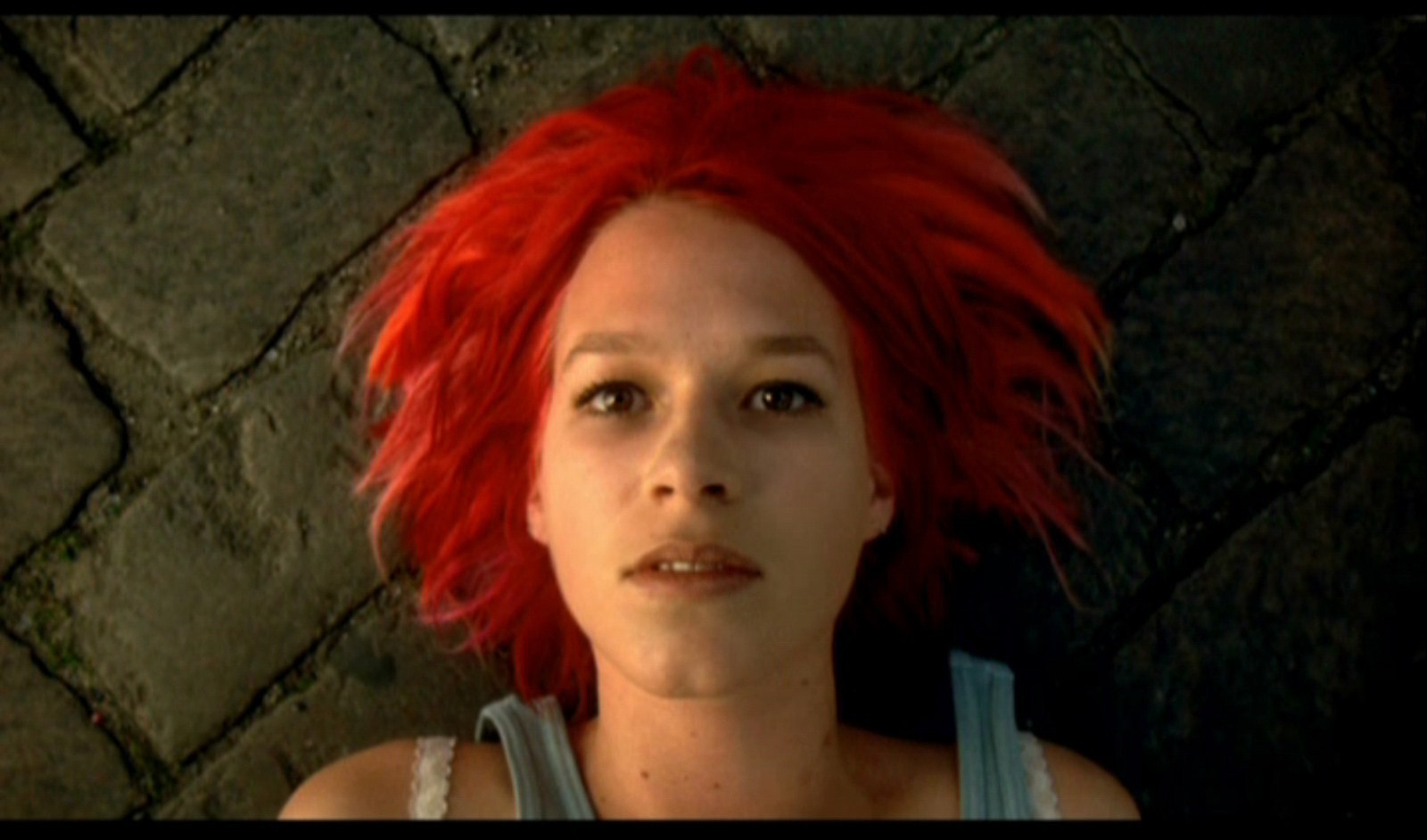 Over the course of the three running sequences, Lola definitely changes. In the first run, she is a much more passive person. She scoots past the man and his dog with a little fear. When she confronts her father and he disowns her, she merely leaves the bank, upset and hurt. When she reaches the store that Manni is in the process of robbing, instead of trying to get him out of the dangerous situation, she instead helps him, fearfully (for both her and the audience, to be honest,) handles the guard's gun to hold him and the rest of the store's occupants at bay while Manni collects the cash from the tills. Her (more) passive stance here is rewarded only with her own death.
In Run Two, Lola is tripped by the man with the dog and becomes injured. This, combined with her strengthened determination, spikes aggression in her. When she comes across a biker, whom she'd previously only brushed off in Run One, she snaps back at him. As she confronts her father in the bank, instead of just allowing herself to be thrown out by him, she attacks him, throwing objects across his office. Lola then follows this up by holding him, the cashier, and the guard at gunpoint in order to steal the 100,000 marks. Her aggressive stance is only met with Manni's death at the end, signaling another failure.
By Run Three, however, she becomes more proactive. Again, she leapt the dog instead of cowering from it. When she meets a friend of her father's, she only keeps her journey to find herself a solution. When she misses her father at the bank, she goes to the casino and uses some of her own money to attempt a solution. Instead of going completely passive and asking someone else for the money, she merely asks for the opportunity to make the money herself, thus freeing herself from the debt to others without taking from others what is not rightfully hers. She asks the casino employees to allow her to play, and when she wins, she takes her winnings to save Manni. When she hops onto the ambulance, instead of just hoping for a ride, in her own way, she pays back by helping the patient who was dying. All of her efforts are rewarded at the end with not only her own life and Manni's life, but also her winnings from the casino.


No comments:
Post a Comment