Wednesday, October 23, 2013

The Marriage of Maria Braun

The Marriage of Maria Braun was directed by Rainer Werner Fassbinder in 1979. The original script, which he had written, entitled The Marriages of Our Parents, was and eight-hour-long story that Fassbinder relented and gave to Peter Märthesheimer and Pea Fröhlich to condense.


The film follows the life of Maria Braun beginning with her marriage to her husband, Hermann  in West Germany in the final days of WWII. After a day and a half of marriage, he has to leave her and she is left to support herself and her mother. As the war comes to a close and occupation soldiers move into the neighborhood, Maria finds herself a job at a local bar, which caters to the Americans. After being informed that Hermann was killed in battle, Maria catches the eye of and falls for a black American soldier. The two begin a love affair and he teaches her English in this time. Months later, however, Hermann returns home to find the two of them in bed. He barely fights against Bill, the American, who is, himself, a reserved man. When the two do become locked in struggle however, Maria hits Bill over the head with a bottle, accidentally killing him. When she is brought up on charges, Hermann takes the blame and goes to prison for her. She tells him that while he is there, she will wait for him, and build a life for them.
And she does. On her way home one day, she meets and charms a French businessman whom she persuades to give her a job. In the company of him and his business partner, she takes big risks and the company quickly grows. She builds herself a decent living and buys a house. During this time, she begins an affair with the Frenchman, Karl Oswald, who is madly in love with her. She tells Hermann of the affair, and tells him that it is necessary to maintain her ability to work the job, reminding him that he is her true love and husband. Oswald, however, finds out about Hermann and visits him in prison, where, we later find out, he told Hermann that when he gets out of prison, if he were to stay away from Maria until Oswald died, he would leave the rest of his fortune to him.
Maria is hurt but unswayed when she discovers that Hermann had left prison upon his release, and directly went to travel abroad, instead of waiting for her to come. She continues her work and her devotion to building a life for the two of them. But she has and continues to steadily change. She has become more materialistic, and less of the light-hearted woman she was at the beginning of the film. There comes even a moment where she accidentally places her purse into a flower arrangement, instead of the rose she was holding. She tells herself, "Don't get peculiar on me now," recognizing her own beginning instability. Lighting a cigarette on the gas stove, she blows out the flame, failing to turn off the gas.
When Oswald does finally die, Hermann returns to Maria, and she is overwhelmed, immediately turning to the role of his wife; giving him food, a place to sleep, etc . . . When they are interrupted by Oswald's business partner to have the will read. When Maria discovers the deal between Oswald and her husband, she sends the business partner away. After attempting to collect herself, she lights another cigarette and there is a sudden explosion, presumably killing her and Hermann.


"The End of Utopia"

Maria Braun's life after her marriage to Hermann can be seen as a mirror to that of Germany during the same time period. As she gives up her delusions of the war, that her husband will return home, so too, did the German people finally give up on their idealistic dream that had been fed to them by the Third Reich. Maria, desperate to find herself again and to support herself and her mother, finds a job working at a bar catering to the American occupational soldiers. Here, we see Germany begin to take in and cater to the Western capitalistic ideals in order to support itself. When Maria's love affair begins with Bill, this is the ultimate sign of Germany's embrace of America, in the sense that they had just lost their own identity and needed the support of another to help them. It's interesting to note that, just as she does when she inform Bill of the death of her husband, in every moment of the film that Maria is shown condolence or emotional support, she simply stands, numbly, not reciprocating. It's as if she, as a mirror for Germany, represents the emotional numbness that Germany portrayed during that time. They gave little reaction to all that had come of the war and did not really react in any way to what happened to them over the course of the next few years.
When Hermann returns home, Maria looks as if she has just had a reawakening. Standing trial, she informs the judge that she was fond of Bill, that she loved her husband. This is very symbolic of Germany's reconnection with itself. They did not want to fully cast off their identity, but were willing to adopt to some of the American ideals. Yet, Hermann's immediate surrender also shows Germany's unwillingness or continuing  inability to come to terms with the reality of the war.
Maria begins working for Oswald, becoming a clever and somewhat ruthless businesswoman, trading in her humble lifestyle of making sure she and her mother had enough to eat, to having lavish clothes and meals; Germany's buy into the bourgeois lifestyle of the American culture. During a family dinner, the radio plays over the conversations of the family, the chancellor Adenauer explaining that he was against the rearmament of Germany, the family barely listens, too preoccupied with the food and their gossip.
Later in the film, after Oswald's death (the first realizations to the German people of the consequences and eventual fate of the capitalist movement and their "miracle period",) Maria sits in a lavish restaurant eating dinner. When Adenauer again is heard over the radio talking about why the rearmament of Germany was essential, Maria stands in an attempt to walk away haughtily and only doubles over as she vomits. "The old capitalist ideas of property and freed and all the traditional bourgeois values were restored. The will to reform had all too  soon exhausted itself," (Kaes, 102).

When the film ends with Maria's realization that the most successful part of her life, in her eyes, had been a mere monetary transaction between two men, that her choices and her life, had ultimately not been hers to make, she completely breaks down, and it is here, through intention or an unstable moment, she causes the explosion that kills her and Hermann and destroys that house that she had worked so hard to afford. Here, there is nothing left to reconcile or save. To Maria, much like to Fassbinder himself, all hope was lost and in that instance, there is no point to living anymore. Maria makes the ultimate decision, one that she alone can totally control; the decision to end her life and that of her husband's. ". . . the attitude of complacency and amnesia that Fassbinder wanted to destroy–a terrorist act that included self destruction, (Kaes, 103), was the only way he could perceive Germany's future.

Wednesday, October 2, 2013

Triumph des Willens

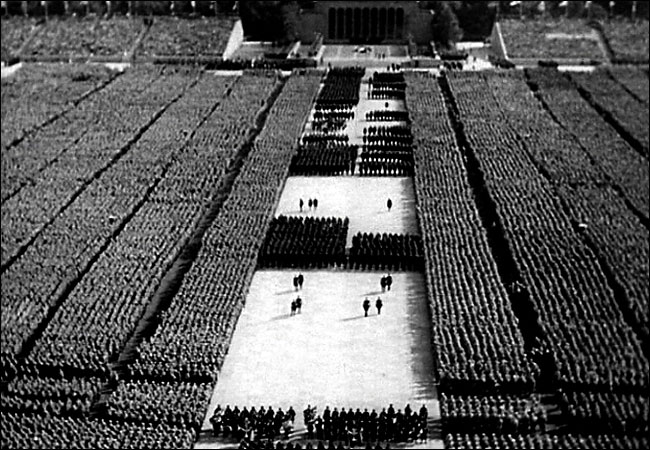
Triumph of the Will (1935) directed by Leni Riefenstahl is a film that depicts a series of Nazi ceremonies and parades, namely the Nazi Part Congress in Nuremberg. Though the film was awarded several prizes at its release for its innovation, it was heavily criticized after WWII for glorifying the Nazi party. Since, it has become the subject of great study, to look at the psychological circumstances that led to and resulted from the Nazi Party's reign, and for purely filmic technics.


1. The Nazi's goal was totality. Propaganda was their tool. Explain this and relate it to the film.

Nazism was based in fascism and totalitarianism. They relied on the dictatorship of Adolf Hitler and created a system of government that was reliant on this ideal. Such a change cannot occur quickly and they knew they had to "win the hearts of the people" before they could achieve their political gain. In arguably the most effective and stunning way possible, they did this with the use of propaganda. They wanted their message to reach the entire country and they wanted to convince the people of their plan. They knew that using more intimate methods was the most psychologically effective because it would make the people feel closer to the party and ultimately, Hitler. To reach the greatest number of people possible and to achieve the personal aspect, the chose to use propaganda in the form of radio, film, and newsreels.

The Nazi Party's message was often one of peace and restoration of Germany's former glory. They knew, in the dark times of disallusionment that Germany was facing after WWI, it would be the most effective way to reach out to the people and gain their support. They wanted people to be convinced that only Hitler and the Nazi party could deliver them to a better future.

Such was the case with Triumph des Willens which was commissioned by Hitler himself who wanted Leni Riefenstahl specifically to do the film. He had seen her other work and was convinced that no one else would be able to accomplish what they wanted out of the film. The film used some very powerful images to back up the goals of the Nazi Party. The party often spoke of Hitler as a "savior" making deliberate reference to him being the only leader capable of helping the German people. Leni even began the film by showing Hitler descending in an airplane and landing in Nuremberg, descending as if he were "from above".

Throughout the entire rest of the film, Leni is careful in every frame she shows Hitler in. He is almost always shot from a low angle, making him appear larger and more prolific. Also, she usually places him in front of some light source, usually the sun, to give a halo effect around his head. These were undoubtedly very deliberate in order to strengthen the "savior" approach. Hitler is also very frequently shown in front of or separated from everyone else. When he walks down a lane with two others, they are shown behind him, even their shadows. The film frequently switches between shots of the "the masses" and of Hitler. They are rarely show together. This works to separate Hitler from the rest, to show his dominance and importance over 'the people'.

Another strong aspect of the film is its portrayal of structure. Often, the locations of the shooting had powerfully structured aspects, such as the stonework of the WWI Memorial where Hitler gave his last speech of the Congress. Even the masses, the soldiers of the SS and SA, we shown in tight groupings of geometric shapes, like moving bricks, giving the impression of solidity and strength.


The film tended to focus on the speeches made by various officials and Hitler. They all used their normal rhetoric of a peaceful future, of the restoration of the German people's glory, and of the unity and obedience of the people under Hitler. This repetition was key to the message of the Nazi Party.

Wednesday, September 11, 2013

Next Week: Nosferatu, A Symphony of Horror

I figured I'd start announcing the upcoming film so that if you're interested you can have a chance to watch it before the discussion goes up.
Next week we will be viewing one of the starters of the horror genre:

Nosferatu, A Symphony of Horror.


Das Cabinet des Dr. Caligari // The Cabinet of Dr. Caligari

This week's film was The Cabinet of Dr. Caligari (1920). Written by Hans Janowitz and Carl Mayer, and directed by Robert Wiene, the film is a little different from the screenplay. Here, I will be discussing the film for the most part, and will state "the screenplay" if I'm referring to the original write of it.

:WARNING - This blog contains spoilers for the movie, The Cabinet of Dr. Caligari. :


The Cabinet of Dr. Caligari is a wonderful spectacle of a film from the silent movie era. It has a framework story of the main character, Francis, telling a priest of the strange occurrences he and his fiancé had witnessed. In the flashback story, he tells of a man named Dr. Caligari who came to town for a festival, announcing that he would present a somnambulist, or "sleep walker", who would wake upon his call for the first time in 23 years. We don't see the somnambulist the first time around, but that night
the town clerk, who had previously been rude to Dr. Caligari when filling out a request to show his exhibit at the fair, is found murdered.

The next day, Alan and Francis visit the fair together, where they happen across Dr. Caligari's exhibit. The somnambulist, named Cesare, does indeed awaken to Dr. Caligari's command, who then invites people to ask him questions. Francis' friend, Alan, asks Cesare when he will die. Cesare informs him that he has until dawn the following day, and Alan and Francis leave in a fit of fright. When Francis manages to calm his friend, the two encounter Jane, who, Francis informs us, both he and his friend are in love with. Francis proceeds to tell us that he and Alan had agreed to remain friends, none-the-less, and would let her choose. Soon afterward, we witness Alan murdered by what we only see as a shadow.

Distraught at the news, Francis begins a hunt for his friend's killer. As he attempts to find the man responsible, the police arrest another who attempted to murder an elderly woman in the middle of the night. At first, the feel the case is closed, until the attempted murderer reveals that he was only trying to take advantage of the two previous killings, hoping the police wouldn't suspect him, assuming it was like the other two mystery murders.
At one point, Jane, in trying to track down Francis to tell him the news, runs into Dr. Caligari who brings her into his tent to show her Cesare. Frightened of the somnambulist, she runs and tells Francis what happened. Francis, who has begun to suspect Dr. Caligari, goes to his cart that night and watches him sleep over the open coffin of Cesare. While he is keeping watch over his suspect, however, we see Cesare creep into Jane's room. He at first attempts to stab her, but is overcome with emotion for her, and after a brief struggle, she feints and he steals her away into the night, pursued by a mob.

Exhausted, Cesare collapses, laying Jane down and running away. Meanwhile, when Francis hears that Cesare has kidnapped Jane, he brings the police to Dr. Caligari's cart, telling them he had kept watch all night, and wondering how it was possible to see the somnambulist still asleep in his coffin if he had been spotted in town. The police barge into the car and pull Dr. Caligari and the coffin out, only to discover that the coffin contained only a dummy of Cesare.  Dr. Caligari escapes and Francis follows him to the sanitarium, where he discovers that Caligari is actually the asylum's director. With the help of the fellow asylum workers, they investigate "Dr. Caligari", going through his office in the middle of the night. They find his journals where he describes a monk from centuries before called "Caligari" who used a somnambulist to commit a series of proxy murders. The director had become obsessed with the psychology behind this and spends years trying to figure out if it was indeed possible. After they confront the Dr. with these charges, he only breaks down after discovering that Cesare is dead, and he flies into a deranged state, becoming a patient in his own asylum.

As Francis finishes the story, we return to the framework, where we see the priest give Francis a skeptical yet terrified look, before leaving. We are then shown that Francis is in fact, a patient in the sanitarium himself, along with Cesare, and Jane, and that the "Dr. Caligari" is in fact the director of the asylum.

Reflections

2. Motifs and Symbolism

The amount of symbolism in Dr. Caligari is amazing. Considering it was part of the German Expressionism Movement, that's not surprising. German Expressionism was a brief but monumental shift in the the arts, including literature, art, theatre, and film. It would eventually lead to the more global movement of Surrealism, but the advent of Expressionism created ideals and philosophies that are still practiced in part or entirety today.

German Expressionism reached its peak in the 1920's in Berlin and was a reaction to the turbulent times of Europe in that era. Arguably one of the fastest changing eras in history, Europe was teetering on the edge of the fall of Imperialism, which had dominated the continent for centuries. The rise of media brought the truth of the destruction war was closer to people, which many consider attributed to the ideals of honor and glory in war being lost forever. Furthermore, Germany has had a long and truly rich history of culture that's really far too much to even summarize here, but WWI had shaken the German people to the core. Political unrest, a shift in societal views, and a severe drop in the economy created country-wide disillusionment. Since the German government had worked to isolate the people during WWI, the loss of the war and the social strangulation was a huge blow to the once-proud peoples.

This is what led to the highly stylized anti-realism of the Expressionist movement. The people were in shock and disbelief, which lent itself to the dream-like qualities of the Expressionistic art. Shadows were a huge part of the movement's philosophy, which utilized chiaroscuro, or the study of light and dark and, most importantly, everything in between. As I mentioned earlier, in the loss of glory and honor in war, there came another way of thinking that came about as a reaction to the realization of the horrors of war and in contrast to Patriotism. This thinking was brought about by the moral conflict that struck many European countries at the time. There was a struggle for society as a whole to figure out which is more important to be loyal to: country? government? religion? humanity? self? There were no clear answers, and with the rise of Psychology, it was becoming an ever harder question to answer. Chiaroscuro was the embodiment of these struggles. There would never again be a villain and a hero, just more shades of grey.

(Further entries note specific examples of symbolism)

3. Staging: costume and makeup, acting and pantomime

The Cabinet of Dr. Caligari explores this in great detail. The highly stylized sets were indicative of the previously mentioned dream-like state. This is further underscored by the contrasting styles of the framework story to the narrative. In the framework, the sets are more realistic, and the actors less "painted". Expressionistic films really touched upon the shift from theatre to film by using exaggerated acting, and this included heavily painted faces. In the framework story, the priest, Francis, and "Dr. Caligari" (I use the "" here to indicate that the character is in the position of sanitarium director,) have lightly painted faces. In the narrative, however, everyone is much more heavily painted in white and black, exaggerating their features. This is most notable with Dr. Caligari, who looks like an oil painting in the narrative. These made-up faces and stylized sets were symbolic of the dream-like state and distortion of reality that the German people were experiencing.

One my favorite aspects of the film is the dig at bureaucracy, of which the country was experiencing an explosion of. The shift of power from the Imperialist monarchy to the newly installed Democracy and its bureaucratic partner triggered a resentment among people. This is depicted in the film by the use of levels. When Dr. Caligari goes to register a permit for his exhibition at the fair, for instance, he's met with a grumpy town clerk who sits on a high stool and looks down at him. The police, too, sit atop high stools and look down at Francis as he asks their help in finding his friend's murderer.
*(The struggle of the people vs. bureaucracy is wholly explored in M by Fritz Lang, if you're interested in it.)

7. Message

Pinpointing a specific message is a little difficult since, given the written story, the filmed story, and the cultural and historical significance of the film, the interpretations can vary greatly. The part I choose to focus on then, is one of my favorite aspects of art: morality.

As I mentioned earlier, the look into the many shades of light and dark was in part a result of the widespread questioning of morality. This is also exemplified by the character's relations to each other and the way we can interpret them. Dr. Caligari seeks to control and utilize Cesare as weapon. He uses the somnambulist to kill those who have wronged him or seek to expose him. In his writing, he even says that he is fascinated by the idea of using a somnambulist to do what he (the somnambulist) would, in a waking state, find abhorrent. In this, we can see Dr. Caligari as the government, or power. Cesare, the tool of his destruction, is seen as the military, or singularly, a soldier.

A soldier carries out orders. That is their existence. For as long as it's been around, the ideal is that a soldier is simply to do as told, with the understanding that there is a trust that what they're doing is for the good of their country/people, like an unwritten contract. Here, however, there is a questioning of whether or not that contract is being upheld by the power.

You see, both Hans Janowitz and Carl Mayer were soldiers who became conscientious objectors, which, while not a new sentiment, was certainly a fast growing one starting with WWI. Along with many like them, they began to question what they were really fighting for and, as mentioned, whether it was the right thing to be fighting for. Dr. Caligari uses Cesare to kill anyone that he feels, actively and consciously disregarding whatever Cesare might feel.


This throws into another argument: who is morally responsible? While the gut reaction to say that Cesare, despite being the one actually killing people, is innocent on the stance that he is essentially brainwashed and it's not his decision, the third victim puts that into question as well. When Cesare is ordered to kill Jane, he succumbs to emotion and cannot follow through with it. This demonstrates his awakening to his actions, to the horror at what he's actually doing. Suddenly, the audience is forced to wonder with Cesare being "asleep" justifies his actions, and by extension, whether a soldier's chosen ignorance, "sleep", to their actions, are justifiable.

The fact that he is a somnambulist would suggest a relief of responsibility. But the fact that he becomes aware basically negates that. When Cesare instead decides to kidnap Jane, it's like he's trying to steal away innocence, holding on to it for dear life with the his morality, the mob of townsmen, chasing after him. His burdens become too much, and he eventually collapses in exhaustion.  The choices of Dr. Caligari, to use Cesare to do his bidding in exacting revenge and in an attempt to keep his secret, not only had a heavy toll of him, but brought about his destruction. This can be attributed to the feelings of destruction the people felt, which had been brought about by the greed and corruption of those in power seeking to maintain their power.

It's an amazingly difficult concept that is not only an interesting analysis, but really, a necessary one. Thoughts?


Wednesday, August 28, 2013

Lola Rennt


:WARNING - This blog contains spoilers for Lola Rennt // Run Lola Run :


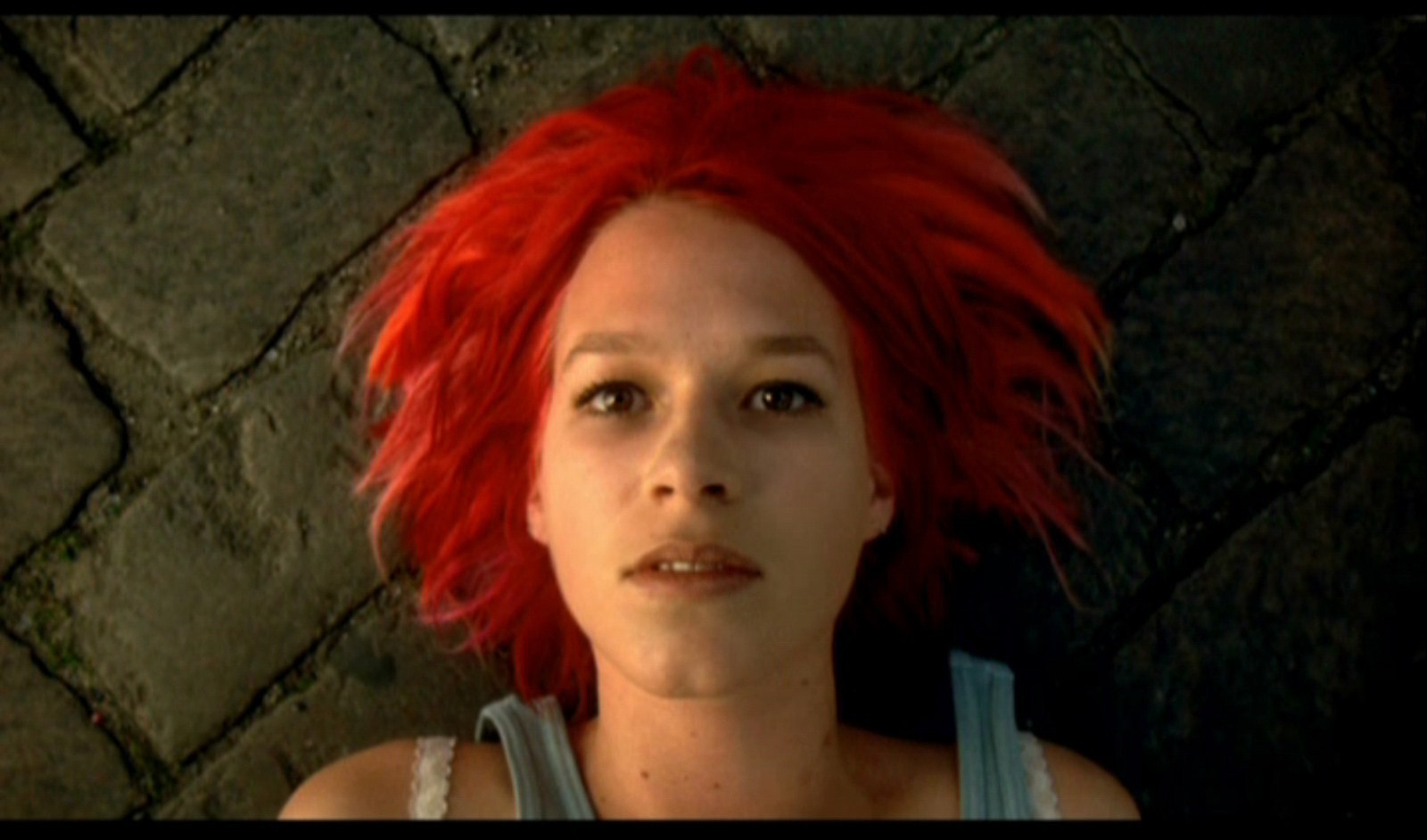
For our first film, we watched and discussed Lola Rennt, (or the American Run Lola Run). The film came out in 1998 and was directed by Tom Tykwer. The film itself is about a young woman, Lola, who finds herself with twenty minutes in which to come up with a way to save her boyfriend, Manni, from the fate that awaits him when it's found out that he's lost 100,000 marks of another man's money. And he's of course the last kind of man you'd want to owe money to. If Lola doesn't come up with the money in time, Manni plans to rob a store to help make up for it. 

As the film progresses, we see three distinct sections. In the first, Lola runs to her father, a banker, to ask for the money, but instead finds out he's leaving her and her mother for another woman. With little time left, she tries to at least stop Manni, but arrives too late, after he's already began the robbery. She attempts to help him and at first the seem to succeed, until the police show up, and in a moment of distraction, Lola is shot. As she lays dying, we are treated to an intimate moment of her and Manni where Lola asks him how much he loves her. He tries to convince her of the lengths he would go to for her, but she does not completely subscribe to it, convinced that if she'd died, he'd be saying the same thing to another woman. When we come back to the street, Lola says she is not ready yet. 

We are transported back to the start of her run, and she begins the journey again, running down the stairs of her apartment, just as before. Only, this time, a man and his dog that she had passed in the previous Run unharmed, now trip her down the stairs and she's injured. Her journey is slightly slower now and she reaches her father's a little later, after he finds out that his aforementioned mistress is pregnant with another man's baby. Fed up with people before she even gets to the bank, Lola's father doesn't even give her enough time to describe her predicament. Lola, running out of time, decides instead to rob the bank. This goes off successfully, and she runs to meet Manni, catching up with him just before he wants into the store he plans to rob. However, just as the two relax and start to walk away, Manni is hit by an ambulance that was rushing a man to the hospital. Now, it is Manni who lays in the street dying. Here, we go back to that intimate moment, and this time it is Manni who is asking the questions. He asks Lola what she would do if he died. Going back to the street, Lola tells him "not yet".


For the third time, we go back to the beginning. Lola learns from her mistakes and begins to act accordingly, jumping over the dog and bounding off to meet her father. We find out that a man Lola had run into in Run One and Run Two, causing him to get into a car accident both times, finally arrives to his destination on time in Run Three. The destination happens to be picking up Lola's father from the bank, so when she gets there, her father has already gone. Out of options, she decides to keep running until she comes up with a new idea and ends up at a casino. She's allowed to play only two games of roulette before making the money she needs and running off to meet up with Manni. In this Run, Manni happens across the man who took the original money and after giving chase, finally retrieves it. Lola arrives to the square where she planned to meet Manni only to see him shaking hands with the man he owed the money to. All is well and the two walk off together. 

The major themes we discussed in the class concerned the ideals of free will vs. determination, liebestod, and the idea of turning back time to try again. 

The varying outcomes of each Run suggests that the idea of "determination", where your life is already written out for you, is a falsehood. Similarly, the minor changes that occur in the separate Runs, for instance leaping over the dog in Run Three saves her time that merely passing by the dog in Run One didn't ultimately causing her to miss meeting her father instead of talking with him, would lend itself to the idea that even minuscule changes can have impressive effects on our futures.

The theme of liebestod, or love/death, is underlined by the use of the colour red in the film (Lola's hair is red, and the two intimate scene bookends are washed in red, and is the uncommon colour of the ambulance the runs over Manni in Run Two,). Liebestod is also shown by the deaths of Lola and Manni in Runs One and Two, respectively, as well as the implied death of Lola's father in Run Three, which is the only outcome where is happily accepts his mistress without confronting Lola and disowning her.

Reflection Questions for Lola Rennt
(choose and respond to two questions from a provided list)

3) Describe the music. When is techno music used in the film? What is the difference in the text of the predominate song that accompanies the three runs? What other styles of music can you identify in the film?

Now, unfortunately we ran out of time at the end of the class and we didn't get to talking about the music, which is unfortunate because the music is usually the first thing I notice about a film. The music in Lola Rennt was chosen very well and brings up more interesting points. 

The majority of the music is techno, with only one really noticeable exception. During the getaway from robbing the store in Run One, when it at first seems that Lola and Manni might be okay, the song "What a Difference a Day Makes", originally by María Grever, plays. The song's message is appropriate really for the entire film, expressing how much one's life can changed based on meeting another person. Lola's life changes because someone stole her moped, causing her to be late picking up Manni, who takes the metro and loses the money. Various people's lives through the film also change as a result of their encounters with Lola. During each run, their varied lives are shown through a series of Polaroids. However, the song has a much slower tempo than the rest of the music in the film and when it is played, it is actually quite jarring. This in fact lends itself to giving the audience the feeling that, despite the appearance that all is well, something is wrong and this story is far from over.

The music throughout the rest of the film, particularly in the beginning, is fast paced and keeps the audience's heart rate up along with Lola's in her running across Berlin. In fact, the writer/director of the film itself, Tykwer, also had a hand in writing the music and its lyrics, so it becomes all the more fascinating when we listen to the words.


In the Run One song, she talks about how she wished she was princess who had armies at her command and a writer who sees what's yet unseen. The majority of the lyrics in the first song as somewhat passive. She's hoping merely for the power to make others do her bidding or for someone/something to show her what she's not seeing. Like Lola running ask her father for help, the sentiment is of finding someone else to do the action that will help her help Manni.

In the song, Run Two, the lyrics change. They express a need to never let go and a strong desire for a more active hand in the situation. She wants to go, to fight, to rush. There's more determination and conviction: "We will kiss, we will laugh, we will be a part of what is said to be a union of the heart." This determination is shown in her resolve as she goes as far as robbing a bank in order to obtain the 100,000 marks. An aggressive action to get what she needed.


The third song does transition back into the same lyrics as the first, but instead, the words that stick out the most are no longer the ones that seem passive. The most prominent lyrics are of a wish to be a hunter in search of different food, the wish to be a person with unlimited breath, to be a heartbeat that never comes to rest. Instead of emphasizing other people helping Lola, the lyrics instead emphasize her finding the strength within herself to be the active one in the situation, to be the one who helps herself, finds the solution. It underlines Run Three as, instead of asking her father for the help, she finds a way to help herself.  

The music of Run Three is interestingly accompanied by this:


The percussion and vocals lend themselves to a northern African tribal feel, like a Sahara hunt. This portion underlines the primary lyrics of Run Three, "I wish I was a hunter in search of different food," occupying Lola's hunt for a solution to saving her love. A different solution, since her first plan, going to her father, did not work. 

Furthermore, it gives a strange, mystical feeling, which plays well with people's reactions to Lola when she goes into the casino. She implores the woman at the front to allow her entrance despite her shabby look and shortage of money. The woman obliges and Lola puts her money down on the roulette table. When she wins, and subsequently puts her winnings directly back onto the table, everyone else just looks at her, stunned. One of the casino employees tells her she has to go, but again, she asks him to let her stay for just one more game. There is such earnest in her that he allows it, but it is almost as if she has a much more powerful effect on him; like she is an animal of beauty that he can't quite understand. 

This sentiment is felt again when Lola later hitches a ride in the ambulance that had killed Manni in Run Two. At first the EMT shouts at her that she has to leave, but when the patient is enraptured with her and she holds his hand, connecting with him as he recovers, you again feel that overwhelming power of hers. 

The music plays such a strong suit in the film, it is definitely worth studying the soundtrack and then revisiting the film.

7) Does Lola change at all in the course of the three running sequences? Why does Tykwer reward her with success at the end?

Over the course of the three running sequences, Lola definitely changes. In the first run, she is a much more passive person. She scoots past the man and his dog with a little fear. When she confronts her father and he disowns her, she merely leaves the bank, upset and hurt. When she reaches the store that Manni is in the process of robbing, instead of trying to get him out of the dangerous situation, she instead helps him, fearfully (for both her and the audience, to be honest,) handles the guard's gun to hold him and the rest of the store's occupants at bay while Manni collects the cash from the tills. Her (more) passive stance here is rewarded only with her own death.


In Run Two, Lola is tripped by the man with the dog and becomes injured. This, combined with her strengthened determination, spikes aggression in her. When she comes across a biker, whom she'd previously only brushed off in Run One, she snaps back at him. As she confronts her father in the bank, instead of just allowing herself to be thrown out by him, she attacks him, throwing objects across his office. Lola then follows this up by holding him, the cashier, and the guard at gunpoint in order to steal the 100,000 marks. Her aggressive stance is only met with Manni's death at the end, signaling another failure.

By Run Three, however, she becomes more proactive. Again, she leapt the dog instead of cowering from it. When she meets a friend of her father's, she only keeps her journey to find herself a solution. When she misses her father at the bank, she goes to the casino and uses some of her own money to attempt a solution. Instead of going completely passive and asking someone else for the money, she merely asks for the opportunity to make the money herself, thus freeing herself from the debt to others without taking from others what is not rightfully hers. She asks the casino employees to allow her to play, and when she wins, she takes her winnings to save Manni. When she hops onto the ambulance, instead of just hoping for a ride, in her own way, she pays back by helping the patient who was dying. All of her efforts are rewarded at the end with not only her own life and Manni's life, but also her winnings from the casino. 


Monday, August 26, 2013

An Introduction

This is my newest blog based on the course I am taking at McDaniel College called "German Cinema". The class is taught by Dr. Esa and focuses on some of the most prominent works created in film by German artists.

The class itself is taught in English, and all of the films viewed are in German with English subtitles.

What will be posted is responses to films we watch as well as various assignments and possibly some other tidbits. Please feel free to comment/discuss. That is, after all, the key to learning for everyone!