
1. The Nazi's goal was totality. Propaganda was their tool. Explain this and relate it to the film.
Nazism was based in fascism and totalitarianism. They relied on the dictatorship of Adolf Hitler and created a system of government that was reliant on this ideal. Such a change cannot occur quickly and they knew they had to "win the hearts of the people" before they could achieve their political gain. In arguably the most effective and stunning way possible, they did this with the use of propaganda. They wanted their message to reach the entire country and they wanted to convince the people of their plan. They knew that using more intimate methods was the most psychologically effective because it would make the people feel closer to the party and ultimately, Hitler. To reach the greatest number of people possible and to achieve the personal aspect, the chose to use propaganda in the form of radio, film, and newsreels.
The Nazi Party's message was often one of peace and restoration of Germany's former glory. They knew, in the dark times of disallusionment that Germany was facing after WWI, it would be the most effective way to reach out to the people and gain their support. They wanted people to be convinced that only Hitler and the Nazi party could deliver them to a better future.
Such was the case with Triumph des Willens which was commissioned by Hitler himself who wanted Leni Riefenstahl specifically to do the film. He had seen her other work and was convinced that no one else would be able to accomplish what they wanted out of the film. The film used some very powerful images to back up the goals of the Nazi Party. The party often spoke of Hitler as a "savior" making deliberate reference to him being the only leader capable of helping the German people. Leni even began the film by showing Hitler descending in an airplane and landing in Nuremberg, descending as if he were "from above".

Throughout the entire rest of the film, Leni is careful in every frame she shows Hitler in. He is almost always shot from a low angle, making him appear larger and more prolific. Also, she usually places him in front of some light source, usually the sun, to give a halo effect around his head. These were undoubtedly very deliberate in order to strengthen the "savior" approach. Hitler is also very frequently shown in front of or separated from everyone else. When he walks down a lane with two others, they are shown behind him, even their shadows. The film frequently switches between shots of the "the masses" and of Hitler. They are rarely show together. This works to separate Hitler from the rest, to show his dominance and importance over 'the people'.
Another strong aspect of the film is its portrayal of structure. Often, the locations of the shooting had powerfully structured aspects, such as the stonework of the WWI Memorial where Hitler gave his last speech of the Congress. Even the masses, the soldiers of the SS and SA, we shown in tight groupings of geometric shapes, like moving bricks, giving the impression of solidity and strength.
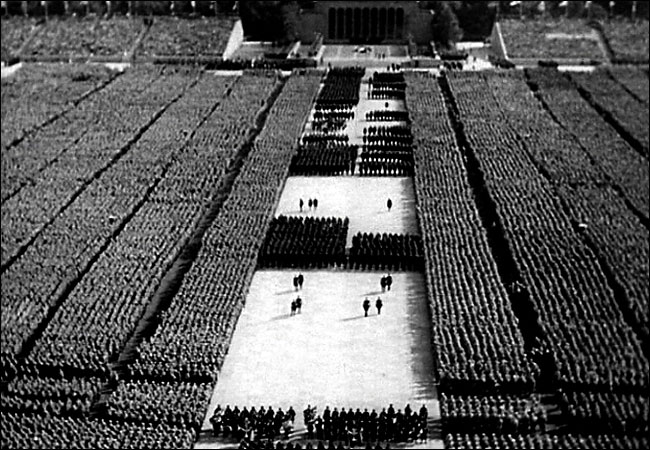
The film tended to focus on the speeches made by various officials and Hitler. They all used their normal rhetoric of a peaceful future, of the restoration of the German people's glory, and of the unity and obedience of the people under Hitler. This repetition was key to the message of the Nazi Party.

No comments:
Post a Comment